
.png)
- Services
- Sustainability
- Company
- Facilities

.png)
.png)
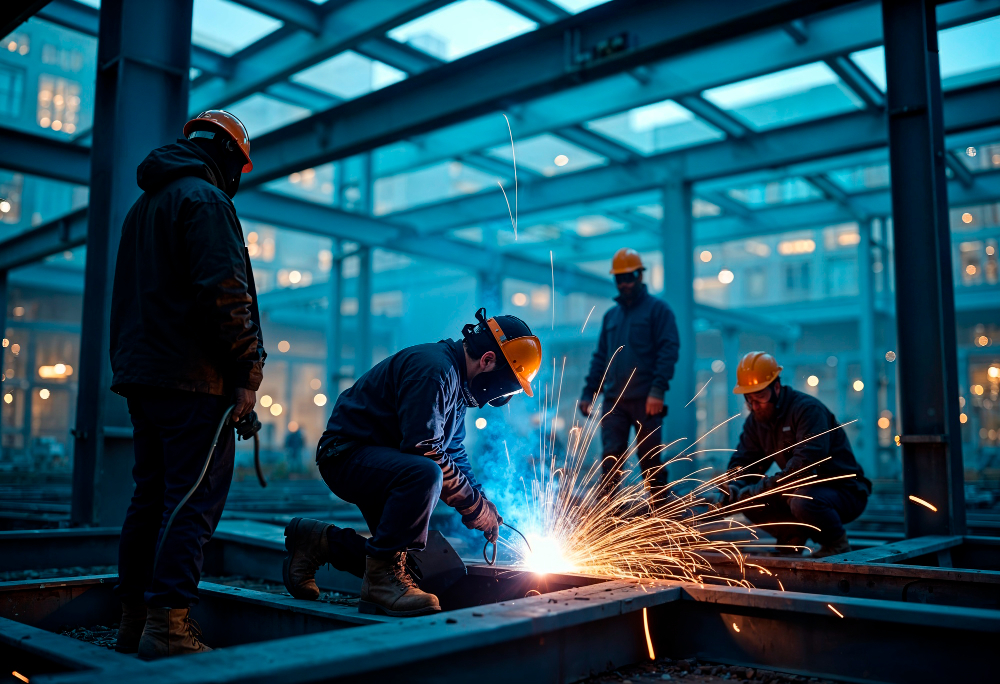
Discover how integrated metal fabrication can simplify production, reduce supplier handoffs, improve quality consistency, and create greater control from raw material to finished component.
Manufacturing a metal component rarely involves one process.
A part may begin with laser cutting or punching, move through bending and forming, require welding or assembly, and finish with a protective coating before it is ready for its final application.
When each of those steps is handled by a different supplier, what looks like a straightforward manufacturing project can quickly become a complex supply chain.
More suppliers mean more transportation, more schedules to coordinate, more quality checkpoints, and more opportunities for information to get lost between one process and the next.
That is why integrated metal fabrication matters.
By bringing multiple manufacturing processes together under one supplier, companies can simplify production, improve consistency, reduce unnecessary handoffs, and gain greater control over how a component moves from raw material to finished part.
Consider a component that needs to be cut, bent, welded, and power coated.
With a fragmented manufacturing model, the cutting supplier completes its operation and ships the component to another facility for bending. From there, it may move again for welding and once more for finishing.
Each transition introduces another variable.
Production schedules need to align. Parts need to be transported and received. Specifications need to be communicated correctly. Quality expectations must remain consistent between companies that may operate with different equipment, procedures, and inspection standards.
If an issue is discovered during a later operation, identifying where it originated can also become more complicated.
The cost of fragmentation, therefore, is not limited to transportation. It can appear in additional lead time, administrative work, quality variation, reword, and production uncertainty.
Every external handoff adds time to the manufacturing process.
Parts may wait to be packed, transported, received, inspected, and schedules into the next supplier's production queue before manufacturing can continue.
An integrated supplier can coordinate these operations as part of a single production plan.
Instead of treating cutting, forming, welding, and finishing as independent jobs, they become stages of the same manufacturing workflow.
This can reduce unnecessary downtime betwen processes and make overall lead times more predictable - particulary for components that requiere several fabrication operations before completion.
Quality in fabrication is cumulative.
A precise cut is only valuable if the bending operation maintains the required geometry. Accurate forming still needs controlled welding to avoid distortion. And a properly fabricated component requires adequate surface preparation and finishing to achieve the expected durability and appearance.
When multiple processes are coordinated by the same manufacturing partner, quality can be considered across the complete production sequence rather than at isolated stages.
Team can anticipate how one operation will affect the next and establish inspection points throughtout production.
The result is not simply quality at one machine or one process. It is consistency from the first operation to the finished component.
When several suppliers participate in the production of one component, manufacturing problemas can become difficult to resolve.
Was a dimensional issue introduced during cutting, bending, or welding? Did a finishing problem originate during surface preparation or from an earlier fabrication step?
With multiple suppliers, determining responsibility can require additional communication, inspections, and time.
An integrated manufacturing partner creates a clearer line for accountability.
There is one team responsible for coordinating the complete manufacturing process and ensuring that each operation supports the specifications of the finished component.
For procurement and engineering teams, that means fewer conversations to manage and a more direct path to solving problems when they arise.
One of the less obvious advantages of integrated fabrication happens before the production begins.
When a manufacturer understands several processes - rather than only one - it can evaluate a component as a complete manufacturing challenge.
A design decision that works well for laser cutting, for example, may create unnecessary complexity during bending or welding. A particular geometry may require additional operations that could potentially be simplified. Material selection, tolerances, bend locations, weld requirement, and finishing specifications can all influence how efficiently a component moves through production.
Looking at these requirements together creates opportunities for Design for Manufacturing (DFM).
The goal is not to change the function of the component. It is to identify ways to manufacture it more efficiently while maintaining the required performance, quality, and specifications.
The lowest quote for an individual process does not necessarily create the lowest manufacturing cost.
When evaluating suppliers, companies also have to consider the costs surrounding production:
Integrated fabrication can remove or reduce several of there variables.
This makes it important to evaluate the total cost of producing a finished component, rather than comparing the price of each manufacturing operation in isolation.
Production requirements rarely remain static.
A project may begin with a small number of components for testing and validation before moving into larger production volumes.
That transition can change which manufacturing processes are most efficient.
Laser cutting, for example, offers flexibility for complex geometries and varying production requirements, while punching or stamping can provide significant efficiency and repeatability for the right higher-volume applications.
Working with a manufacturer that has access to multiple processes makes it possible to evaluate the production method as requirements evolve instead of forcing every project into a single manufacturing approach.
This flexibility becomes particularly valuable when a successful prototype needs to become a repeatable production component.
At STK Industries, we have built our manufacturing capabilities around the idea that metal fabrication should be managed as a connected process.
Our capabilities include laser cutting, CNC bending, punching, stamping, welding, and painting and finishing, allowing multiple stages of production to be coordinated within a single manufacturing operation.
From precision cutting and forming to welding and protective finishes, our teams work across processes to maintain consistency and keep production moving efficiently.
We also work with customers from early manufacturing decisions through prototyping and full-scale production, helping evaluate materials, processes, and manufacturability based on the requirements of each project.
The objective is not simply to offer more processes.
It is to make those processes work together.
Modern manufacturing depends on more than the performance of an individual machine.
It depends on how efficiently the entire production system works together.
Reducing unnecessary handoffs, coordinating manufacturing stages, maintaining consistent quality standards, and creating clear accountability can make the supply chain simpler and more reliable.
For companies sourcing metal components, choosing a manufacturing partner should therefore involve more than asking:
Can this supplier make this part?
A better question may be:
How much of the manufacturing process can they take responsibility for?
At STK Industries, our integrated capabilities allow us to manage multiple stages of metal fabrication under one manufacturing partner — helping our customers move from raw material to finished component with greater control, consistency, and confidence.
Looking for an integrated manufacturing partner for your next project?